
How to Prepare for a Market Crash in Retirement Without Panic Selling

Updated: 15 hours ago
Written by John Macy, Financial Advisor, MBA, Retirement Income Certified Professional® (RICP)
"The stock market is the only market where things go on sale and all the customers run out of the store."
Introduction
Since 1900, the U.S. stock market has experienced dozens of corrections, numerous bear markets, and several declines exceeding 50%. Market crashes are not rare anomalies — they are an inevitable part of long-term investing.
Most investors believe they can tolerate a market crash — until they actually live through one. Watching a retirement portfolio lose 30%, 40%, or even 50% of its value in a matter of months can test even the most disciplined investor.
History shows that market crashes are an unavoidable part of long-term investing. The question isn't whether another crash will occur. The question is whether your retirement plan will still work when it does.
For someone in their 30s or 40s, a market crash may simply be an opportunity to buy stocks at discounted prices. For someone approaching retirement—or already retired—the exact same decline can permanently reduce the amount of income their portfolio can safely provide.
Understanding why requires looking at both history and portfolio mathematics.
What Is a Market Crash?
Not every decline deserves the label "market crash." Investors generally classify declines into several categories.
Market Decline | Description |
Less than 10% | Normal market fluctuation |
10-20% | Market correction |
20-40% | Bear market |
More than 40% | Major market crash |
A 10% correction feels uncomfortable, but historically it has been fairly routine.
A true market crash is different. These are the rare periods when fear overwhelms markets and prices fall dramatically over a relatively short period of time.
Examples include:
1929-1932 (Great Depression)
1973-1974
2000-2002 Dot-com Bust
2007-2009 Global Financial Crisis
2020 COVID Crash (exceptionally fast decline and recovery)
Fortunately, these events are uncommon. While no one can predict when the next one will occur, history suggests that significant bear markets are an inevitable part of long-term investing.
How Common Are Major Market Declines?
One of the biggest misconceptions among investors is believing severe declines are "once-in-a-lifetime" events. History tells a different story.
Since the late 1800s, U.S. stocks have experienced:
Decline | Approximate Frequency |
5% | Nearly every year |
10% | Every 1-2 years |
20% | Every 4-6 years |
30% | Roughly every decade |
40%+ | Several times each century |
50%+ | Rare, but not unprecedented |
The lesson isn't that markets are dangerous. The lesson is that large declines are a normal feature of investing. The reward for earning higher long-term returns (compared to putting your money in safe money market funds or CDs) is accepting that these periods will occasionally occur.
The Recovery Can Take Years
Historically, every major bear market has eventually given way to a new bull market and new all-time highs. While history never guarantees future results, it reminds us that severe declines have consistently been temporary rather than permanent. The challenging part is that waiting for the recovery requires patience.
The following chart illustrates the magnitude and duration of the largest U.S. stock market declines in modern history.

Unless otherwise noted, the recovery periods shown are based on the S&P 500 Price Index reaching a new high. Investors who reinvest dividends generally recover somewhat sooner because dividends continue to purchase additional shares during the downturn.
Perhaps the most surprising observation isn't the size of the declines — it's how dramatically recovery times have varied. Some bear markets recovered in months, while others required nearly a decade or more. Because no one knows which type of recovery the next bear market will resemble, retirees should plan for the possibility of a prolonged recovery rather than hoping for a rapid rebound.
The average investor often underestimates how emotionally difficult it can be to wait five, seven, or even ten years for a portfolio to fully recover.
The Mathematics of Recovering From Losses
One of the most important concepts every investor should understand is that losses and gains are not symmetrical.

As the graphical image above illustrates, a 50% decline doesn't require a 50% recovery, it requires a 100% gain to fully recover.
This is why many successful long-term investors focus first on avoiding catastrophic losses and only second on maximizing returns. Losing less during bear markets often matters more than earning slightly higher returns during bull markets.
Warren Buffett famously summarized this principle with two rules:
Rule No. 1: Never lose money.
Rule No. 2: Never forget Rule No. 1.
Of course, temporary losses are unavoidable when investing in stocks. The deeper lesson is that protecting against severe, permanent impairments can matter just as much as pursuing growth.
Why Market Crashes Hurt Retirees More
A 35-year-old investor may actually welcome a market crash. They're still saving. Every paycheck purchases more shares at lower prices. Future returns may actually improve because stocks became cheaper.
Retirees face the opposite situation. Instead of buying shares, they're selling them. Withdrawals during a bear market permanently reduce the number of shares available to participate in the eventual recovery.
This is one of the primary reasons sequence of returns risk exists. Market crashes, by themselves, don't necessarily derail a retirement plan. It's the combination of a severe decline and ongoing withdrawals early in retirement that can permanently reduce a portfolio's longevity.
Two retirees earning exactly the same average lifetime return can experience dramatically different outcomes depending on whether a major bear market occurs during the first few years of retirement or much later.
The combination of falling portfolio values and ongoing withdrawals can create lasting damage, even if markets eventually recover.
Building a Portfolio That Can Survive Crashes
Since crashes cannot be predicted or prevented, investors should focus on preparation rather than prediction.
Several strategies can help reduce their impact.
1. Maintain Adequate Cash Reserves
Holding one to three years of planned withdrawals in cash or short-term Treasury securities can reduce the need to sell stocks during severe declines. This is the primary idea behind the popular Bucket Strategy: keeping several years of planned withdrawals in cash or other conservative investments while allowing the remainder of the portfolio to stay invested for long-term growth.
2. Build a Secure Income Foundation
One of the most effective ways to reduce the impact of market crashes isn't focused on your investment portfolio — it's creating reliable sources of income that continue regardless of what the stock market is doing.
Many retirement expenses are essential and unavoidable. Housing, utilities, groceries, insurance premiums, and healthcare don't become less expensive simply because the market is down.
If these essential expenses can be covered by dependable guaranteed income sources, retirees gain something incredibly valuable: peace of mind and the ability to leave their investment portfolio alone during bear markets. Every dollar of essential spending that can be covered by dependable lifetime income is one less dollar that must come from selling investments during a bear market.
A secure income floor may include sources such as:
Social Security benefits
Pensions
Immediate or deferred income annuities
Bond or TIPS ladders designed to mature when income is needed
Other predictable income streams
For many households, delaying Social Security can be one of the most effective ways to increase guaranteed lifetime income, particularly for the higher-earning spouse.
The stronger this guaranteed income foundation, the less pressure there is to sell stocks after a large market decline to meet everyday living expenses.
This flexibility can substantially reduce sequence of returns risk by allowing the growth portion of the portfolio more time to recover. In effect, guaranteed income buys something that every retiree needs during a bear market: time.
Many retirement researchers — including Wade Pfau, David Blanchett, and Michael Finke — have argued that retirees often benefit more from maximizing dependable lifetime income than from simply maximizing expected investment returns from their portfolios. A portfolio that generates slightly lower returns but allows a retiree to stay invested through a prolonged bear market may ultimately produce better retirement outcomes than one with a higher expected return but greater vulnerability to forced withdrawals.
Read our guide How to Build a Secure Retirement Income Foundation for more insights on this topic.
3. Diversify Beyond Stocks
While stocks remain the primary engine of long-term growth, other asset classes can reduce overall portfolio volatility.
Examples include:
High-quality bonds
Treasury Inflation-Protected Securities (TIPS)
Cash
Certain real assets (like rental properties or infrastructure assets)
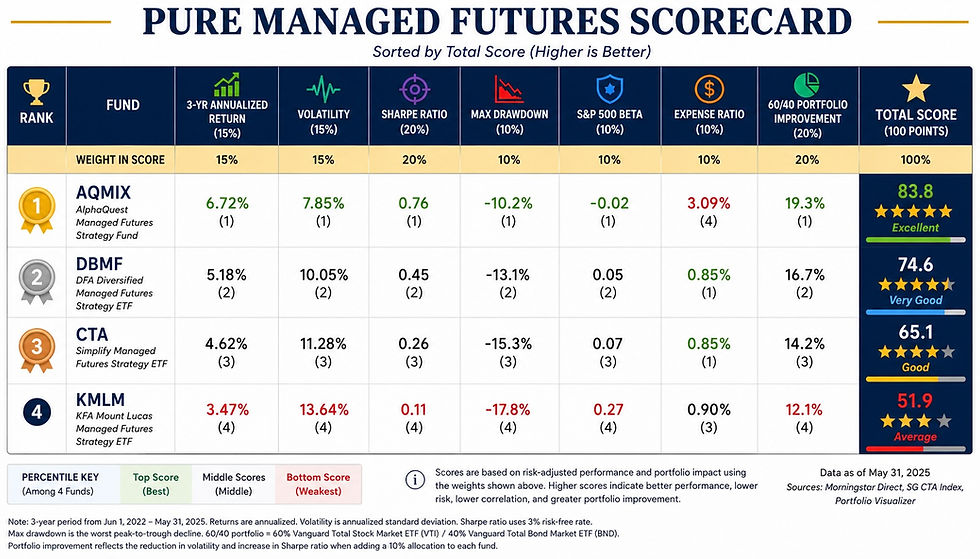
Managed futures
The objective isn't necessarily to earn the highest possible return every year. It's to build a portfolio that can continue supporting your retirement through a wide range of economic environments. Read our guide to Portfolio Diversification for Retirement: Why It Matters.
4. Consider Strategies That Can Benefit During Crises
Some investment strategies have historically performed well during periods when traditional stock and bond portfolios struggled.
One example is managed futures. Unlike traditional investments that generally depend on markets rising, managed futures can take both long and short positions across global futures markets. Historically, these strategies have often performed well during periods of sustained market stress, inflation shocks, or prolonged market trends. While they are not guaranteed to provide positive returns in every downturn, they have shown low long-term correlation with both stocks and bonds.
Because of these characteristics, a modest allocation may help reduce overall portfolio volatility and improve diversification for some investors.
If you're unfamiliar with managed futures, we've written a two-part guide explaining how they work and evaluating the leading ETFs and mutual funds available to individual investors. Read our guide to managed futures here and here.
5. Keep Spending Flexible
One of the most powerful — but often overlooked — risk management tools is spending flexibility. Temporarily reducing discretionary spending during prolonged bear markets allows more of the portfolio to remain invested for the eventual recovery.
Even modest adjustments can meaningfully improve long-term portfolio sustainability. Read our guide How to Safely Withdraw More Than 4% in Retirement for more insights into this strategy.
6. Rebalance Systematically
Market crashes naturally push portfolios away from their target allocations. A disciplined rebalancing strategy forces investors to sell assets that have held up relatively well and buy those that have become cheaper. Although emotionally difficult (in both good times and bad times), this process helps maintain a consistent risk profile and has historically added value over time.
The Goal Isn't to Avoid Every Crash
No investment strategy can eliminate market declines. Nor should it.
Stocks have historically produced attractive long-term returns precisely because investors must endure periods of uncertainty and loss along the way.
The objective isn't to build a portfolio that never declines. That's impossible. The objective is to build a retirement income plan that allows you to continue meeting your financial goals — even when markets inevitably do decline.
Perhaps the greatest danger during a market crash isn't the decline itself — it's abandoning a carefully designed investment plan at exactly the wrong time. A resilient retirement strategy makes it easier to stay disciplined when emotions are running high. It also enables investors to benefit from the recovery that has historically followed every major decline.
Key Takeaways
Market crashes are rare, but they are a normal part of investing.
Recovering from large losses requires disproportionately larger gains.
Crashes are most dangerous during the first decade of retirement because of sequence of returns risk.
Younger investors may benefit from lower prices, while retirees must manage withdrawals carefully.
Diversification, cash reserves, flexible spending, and thoughtful portfolio construction can substantially reduce the impact of severe market declines.
The goal isn't to predict or avoid every market crash—it's to build a retirement income plan that can withstand them.
Since 1926, the U.S. stock market has spent the overwhelming majority of calendar years rising rather than falling. Bear markets capture the headlines and can feel terrible, but bull markets have historically lasted much longer and created the wealth that long-term investors enjoy today.
Final Thoughts
No one knows when the next market crash will occur. It could happen next month, or years from now. No one rings a bell before a bear market begins, which is why preparation must happen in advance.
What history tells us with remarkable consistency is that it will happen eventually.
Investors who build their retirement plans assuming markets will always rise are often caught off guard when reality intrudes. Those who acknowledge that crashes are inevitable — and prepare for them in advance — are far better positioned to stay invested, maintain their income, and benefit from the eventual recovery.
A resilient retirement plan isn't measured by how well it performs during bull markets — it's measured by how well it weathers bear markets.
If you'd like an objective review of your retirement plan, I can help you evaluate how your portfolio, income sources, withdrawal strategy, and overall financial plan might perform under a variety of market scenarios — including severe bear markets, prolonged inflation, and changing spending needs. Together, we can build a retirement income strategy designed not just to grow your wealth, but to help protect the lifestyle you've worked so hard to achieve.
Interested in working together? |
Related pages:
This post is for general education and is not investment advice. Please consult a qualified professional to determine what is appropriate for your specific situation.
Author: John Macy, MBA, RICP®
John Macy is a professional financial advisor and the founder of FlourishingPath Financial Coaching. With over six years of experience as a financial advisor, John helps pre-retirees and retirees design resilient portfolios and income streams for their next act. Read his full story here.


Comments