
Best Managed Futures Funds for Retirement Portfolios

Updated: 3 days ago
Written by John Macy, Financial Coach, MBA, Retirement Income Certified Professional® (RICP)
Portfolio Diversification Series: Part 1: Portfolio Diversification for Retirement: Why It Matters Part 2: Portfolio Diversification: Building a Truly Diversified Portfolio Part 3: Managed Futures Explained: A Key Portfolio Diversifier Part 4: Best Managed Futures Funds for Retirement Portfolios (this article) Part 5: How Much Managed Futures Does A Retirement Portfolio Need? Part 6: Managed Futures vs. Bonds: Which Diversifier Does Better? |
In the first article of this series, we explored what managed futures are, why they can strengthen a diversified portfolio, and how much you might consider allocating.
Managed futures have gone from a niche institutional strategy to one of the most discussed portfolio diversifiers among individual investors. But with more than a dozen ETFs and mutual funds now available, investors face a new challenge: choosing the right implementation. The goal is not to find the fund with the highest return. The goal is to identify the strategy that best improves your portfolio's risk-adjusted performance.
Now comes the practical question: Which managed futures fund should you actually buy?
Today's investors have more choices than ever before. Some funds are designed to complement a traditional stock-and-bond portfolio. Others combine managed futures with stocks or bonds into a single "stacked return" strategy that can potentially replace part—or even all—of a traditional balanced portfolio.
Although these funds all use managed futures in one way or another, they are designed for different purposes. Understanding those differences is the key to choosing the right one for your portfolio. Some investors simply want the best managed futures ETF to diversify their portfolio, while others are looking for a more comprehensive all-weather solution.
At a Glance
If your goal is... | Consider... |
Best overall choice for most investors | DBMF |
Lowest volatility | AQMIX |
Pure trend following | KMLM |
Lowest-cost ETF | DBMF |
Best all-weather fund | BLNDX |
Keep full stock exposure + managed futures (in one fund) | RSST |
There Are Two Different Types of Managed Futures Funds
One of the biggest mistakes investors make is comparing all managed futures funds as though they serve the same purpose. They don't.
They generally fall into two categories.
Category 1: Pure Managed Futures Funds
These funds provide exposure almost exclusively to systematic trend-following strategies.
Examples include:
Their purpose is straightforward: to complement an existing portfolio by adding an asset class that has historically exhibited low correlation with stocks and bonds.
If you already own a traditional 60/40 portfolio—or a diversified mix of stock and bond funds—these are the funds you'll most likely consider.
Category 2: Stacked Return Funds
A newer generation of funds takes a different approach. Rather than asking investors to replace part of their stock allocation with managed futures, these funds attempt to provide exposure to both.
Examples include:
They use leverage through futures contracts to "stack" multiple return streams on top of one another.
For example, a fund may provide approximately 100% exposure to the S&P 500 while simultaneously adding managed futures exposure. Others combine global stocks, bonds, and managed futures into a single diversified fund. These funds are designed to serve as core portfolio holdings, not merely diversifiers.
How We Evaluated the Funds
Many fund comparisons focus only on returns. That approach misses the primary reason investors use managed futures: diversification and the ability to manage portfolio volatility. Therefore, this analysis includes several additional metrics with an emphasis on the fund's ability to diversify and improve the volatility of a traditional retirement portfolio.
Pure Managed Futures Score
Factor | Weight |
Total Return | 15% |
Volatility | 15% |
Sharpe Ratio | 20% |
Maximum Drawdown | 10% |
Equity Beta | 10% |
Expense Ratio | 10% |
60/40 Portfolio Improvement | 20% |
Rather than emphasizing raw returns alone, we placed greater weight on how effectively each fund improved an overall portfolio, since diversification — not market-beating returns — is the primary reason most investors own managed futures.
To calculate the 60/40 Portfolio Improvement score, we modeled replacing 10% of a traditional 60% global equity / 40% bond portfolio with each managed futures fund (resulting in a 54% equity / 36% bond / 10% managed futures portfolio) and evaluated changes in annualized volatility, maximum drawdown, and Sharpe ratio. Funds that produced the greatest overall improvement received the highest scores.
Although correlation with other asset classes was not included as a separate scoring factor, its effects are largely captured by the Portfolio Improvement and Beta metrics.
Each metric was normalized on a 10-point scale relative to the other funds in the comparison. The weighted scores were then combined to produce the composite ranking. This approach rewards funds that consistently perform well across multiple dimensions rather than excelling in only one.
Category One: Pure Managed Futures Funds
AQMIX (AQR Managed Futures Strategy Fund)
Best For: Long-term investors who prefer an institutional mutual fund
AQR has been one of the pioneers in academic research on managed futures.
AQMIX reflects decades of institutional experience implementing trend-following strategies.
Strengths
Deep research foundation
Institutional pedigree
Diversified implementation
Potential Drawbacks
Mutual fund rather than ETF
Higher expense ratio
DBMF (iMGP DBi Managed Futures Strategy ETF)
Best For: Most investors seeking a straightforward managed futures allocation
DBMF has become the most widely used managed futures ETF for individual investors.
Rather than following a fixed trend-following model, DBMF attempts to replicate the positions held by large institutional Commodity Trading Advisors (CTAs). This gives investors access to institutional-style managed futures in a relatively low-cost ETF.
Strengths
Lowest expense ratio among major competitors
Tax-efficient ETF structure
Institutional replication approach
Portfolio diversification
Strong historical risk-adjusted returns
Excellent complement to traditional portfolios
Potential Drawbacks
Can differ from traditional trend-following indexes
Performance depends partly on how accurately it replicates institutional CTAs
CTA (Simplify Managed Futures Strategy ETF)
Best For: Investors wanting a diversified institutional implementation
CTA combines multiple trend models across many markets and is managed by Simplify Asset Management.
Strengths
Broad diversification
Competitive expenses
ETF structure
Strong research team
Potential Drawbacks
Shorter performance history
Less widely followed than DBMF
KMLM (KFA Mount Lucas Managed Futures Index Strategy ETF)
Best For: Investors seeking the purest trend-following strategy
KMLM follows a transparent rules-based index that trades commodities, currencies, and fixed income futures. It is probably the "purest" managed futures ETF currently available to retail investors.
Strengths
Transparent methodology
Excellent diversification
Historically strong performance during difficult markets
Broad futures universe
High crisis-alpha potential
Potential Drawbacks
Higher volatility
Can experience longer periods of underperformance
Category Two: Leading Stacked Return Funds
RSST (Return Stacked® U.S. Stocks & Managed Futures ETF)
Instead of asking investors to reduce their stock allocation, RSST attempts to provide approximately full S&P 500 exposure while simultaneously layering managed futures exposure on top of the equity exposure.
Rather than being a pure managed futures fund that investors can add to an existing portfolio, it can replace a traditional U.S. equity allocation while simultaneously adding a managed futures sleeve.
Its composition is roughly the following. Note that because it uses leverage the total allocation is approximately 200% gross notional exposure. This does not mean the fund borrows an additional 100% of investor capital. Instead, it uses the capital-efficient nature of futures contracts to obtain additional market exposure while holding cash and Treasury securities as collateral.
Asset Class | Portfolio Allocation |
S&P500 | 100% (achieved via a combination of physical equities + equity index futures) |
Bonds | 0% |
Managed Futures | 100% |
Best For: Investors who want to maintain stock exposure while adding diversification.
Strengths
Innovative structure
Excellent capital efficiency
Potentially higher long-term expected return
Maintains equity exposure while adding managed futures
Drawbacks
Uses leverage
Short performance history
Higher complexity
BLNDX/REMIX (Standpoint Multi-Asset Fund)
BLNDX and REMIX are two different share classes of the same mutual fund. BLNDX is the Institutional Class -- it is a lower-cost fund than REMIX and requires a $25,000 minimum initial investment. REMIX is the Investor Class and requires a $2,500 minimum initial investment but has a higher expense ratio. The fund combines global stocks, bonds, and managed futures into a single diversified portfolio.
Rather than adding managed futures to an existing portfolio, it attempts to become a total portfolio solution. Its composition is roughly the following. Note that because it uses leverage (via futures) the total allocation approximately 180–200% gross notional exposure, depending on the fund's current allocations and futures positioning. This does not mean the fund borrows an additional 80-100% of investor capital. Instead, it uses the capital-efficient nature of futures contracts to obtain additional market exposure while holding cash and Treasury securities as collateral.
Asset Class | Portfolio Allocation |
Global Equities | 50-60% |
Global Bonds | 25-35% |
Cash/Treasury collateral | 10-20% |
Managed Futures | 100% |
Best For: Investors seeking an "all-weather" one-fund solution.
Strengths
Excellent diversification
Multiple return sources in one fund
Well-balanced portfolio construction
Maintains equity exposure while adding managed futures
Drawbacks
Mutual fund
Uses leverage
Higher expenses
Composite Evaluation
Here is the scorecard for the Pure Managed Futures Funds
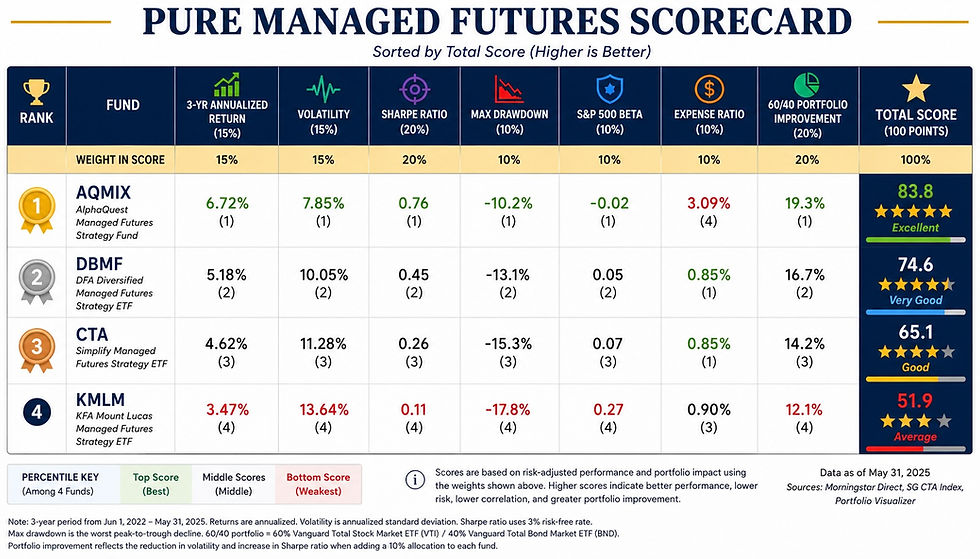
AQMIX earned the highest composite score primarily because of its excellent historical risk-adjusted returns and its ability to improve a traditional portfolio. However, DBMF remains my preferred recommendation for most investors because its ETF structure, lower expense ratio, lower initial investment, tax efficiency, and ease of implementation outweigh AQMIX's modest advantage in historical performance.
Note that there are a couple of other pure managed futures funds such as IMF and FFUT which did not yet have a sufficiently long live performance history to calculate consistent 3-year return, volatility, Sharpe ratio, beta, and drawdown statistics.
Here is the scorecard for the leading Stacked Returns Funds.

Stacked Returns Funds like RSST and BLNDX/REMIX are a fairly new innovation with only two funds that have a 3-year track record or more (RSST actually has just under a 3-year track record as of July 2026). There are several other fairly new funds with variations on the stack returns theme which are not included here. Among the Stacked Returns Funds evaluated here, RSST ranks more highly than BLNDX/REMIX.
Limitations of Scoring FrameworkNo scoring framework is perfect. Different analysts might have good arguments for adding other metrics or changing the weights that were used in this analysis. Managed futures strategies differ in their underlying models, asset universes, and risk targets. Historical performance may not persist in the future, and newer funds such as RSST have relatively short live track records. The composite scores should therefore be viewed as a decision aid rather than a definitive ranking. |
Which Fund Is Right for You?
If you ... | Consider... |
Want a fund with high total return | AQMIX or DBMF |
Want a fund with the lowest volatility or drawdown | AQMIX |
Want the purest trend-following strategy | KMLM or CTA |
Want a fund that provides the greatest diversification to a 60/40 portfolio | AQMIX, DBMF |
Prefer a low-cost fund | DBMF, CTA, KMLM |
Want to keep full stock exposure while adding managed futures (as an all-weather, all-in-one fund) | RSST or BLNDX/REMIX |
Tax Considerations
ETFs such as DBMF, CTA, KMLM, and RSST generally offer greater tax efficiency than mutual funds because of the ETF creation/redemption mechanism. Investors holding managed futures funds in taxable accounts should also understand the tax treatment of futures contracts and annual capital gains distributions. If possible, consider holding managed futures funds in tax-advantaged accounts unless you understand the tax implications.
My Overall Take
For investors simply looking to improve the diversification of a traditional retirement portfolio, DBMF remains my preferred starting point. It offers a strong combination of cost, total return, diversification potential, accessibility, and institutional-style exposure.
Investors who want the purest implementation of trend-following may prefer CTA or KMLM, while those who value AQR's long history of quantitative research in the field may be drawn to AQMIX.
The newer stacked-return funds are exciting innovations, but they serve a different role. Rather than acting as pure portfolio diversifiers, they are best viewed as core portfolio building blocks. Investors considering these funds should understand both the potential benefits and the additional complexity that comes with leverage.
How Much Managed Futures Should You Own?
There is no single correct answer, but the following guidelines might be helpful.
Allocation in Portfolio | Guideline Comments |
5-10% | Conservative allocation that can meaningfully improve diversification |
10-20% | Moderate allocation for investors seeking stronger portfolio diversification |
20%+ | Aggressive allocation that may provide greater diversification but requires patience during periods of underperformance |
The Bottom Line
Managed futures should not be viewed as return-enhancing investments alone. Their greatest value is often revealed during the periods when traditional portfolios struggle most. For investors willing to accept occasional stretches of underperformance, they can provide valuable diversification, improve risk-adjusted returns, and help make retirement portfolios more resilient across a wide range of market environments.
The best managed futures fund is not necessarily the one with the highest return. It is the one that improves your entire portfolio while helping you stay invested through difficult markets.
If your goal is to strengthen a traditional stock-and-bond portfolio, a pure managed futures fund such as DBMF, KMLM, CTA, or AQMIX may be the right choice. If you're looking for a more integrated, all-weather solution, one of the stacked-return funds like RSST or BLNDX may deserve a closer look.
A managed futures fund is just one piece of a successful retirement portfolio. The real value comes from knowing how much to allocate, how it fits with your other investments, and how to build a portfolio that can weather both bull and bear markets. If you'd like personalized guidance creating a resilient retirement income portfolio, I'd love to help.
Interested in working together? |
Related pages:
This post is for general education and is not investment advice. Please consult a qualified professional to determine what is appropriate for your specific situation.
Author: John Macy, MBA, RICP®
John Macy is a professional financial coach and the founder of FlourishingPath Financial Coaching. With over six years of experience as a financial coach, John helps pre-retirees and retirees design resilient portfolios and income streams for their next act. Read his full story here.


Comments