
Inflation in Retirement: How to Protect Your Purchasing Power

Updated: 5 days ago
Written by John Macy, Financial Coach, MBA, Retirement Income Certified Professional® (RICP)
"Inflation is taxation without legislation." — Milton Friedman
Introduction
Imagine retiring with a portfolio or pension that provides $80,000 of annual income. Thirty years later, that same $80,000 still arrives every year — but if inflation averaged 3%, it would buy only what about $33,000 buys today.
Nothing has gone "wrong." Your investments haven't crashed. Yet your standard of living has quietly been cut by more than half.
This is inflation risk — and unlike a market crash, it often works so gradually that retirees don't recognize the damage until it's already done.
The challenge is that inflation risk is asymmetric: a period of unexpectedly high inflation early in retirement can permanently reduce future purchasing power, even if inflation later returns to normal rates of 2-3%.
Most retirees worry about market crashes.
Many worry about running out of money.
Surprisingly few spend much time thinking about inflation.
That may be because inflation is often described as a short-term inconvenience — a temporary spike in grocery bills or gasoline prices. But for someone planning a retirement that may last 25 or 30 years, inflation is much more than a nuisance. It is one of the greatest long-term threats to financial security.
A retiree who ignores inflation may discover years later that a portfolio which once seemed more than adequate no longer provides the lifestyle it once did.
In this article, we'll examine what inflation risk really is, how often it has occurred throughout history, and — most importantly — what investors can do to build a retirement portfolio that is more resilient to a wide range of inflation outcomes.
What Is Inflation Risk?
Inflation risk is the possibility that the purchasing power of your savings declines faster than your investments and income grow.
Many retirees — especially couples — should plan for a retirement horizon of 25–30 years or longer. The probability that at least one spouse lives into their 90s is meaningful. Even fairly low inflation like 2-3%/year causes a steady decline in purchasing power over a long enough time horizon.
Unlike a market crash, inflation rarely arrives all at once. As illustrated by the chart below, it acts more like rust, slowly weakening your financial foundation year after year.

Why Inflation Matters More in Retirement
During your working years, inflation is often offset by raises, promotions, and growing earning power. In retirement, your Social Security, pensions, and investment portfolio — not your paycheck — must carry that burden.
Some retirement income sources adjust for inflation better than others.
Social Security includes annual cost-of-living adjustments (COLAs), although they may not perfectly match every retiree's spending patterns.
Traditional pensions often provide little or no inflation adjustment.
Bond interest payments are generally fixed (except for Treasury Inflation Protected Securities (TIPS) or iBonds).
Cash loses purchasing power every year inflation exceeds its yield.
As a result, retirees can become increasingly vulnerable as retirement progresses.
The Inflation Most Americans Remember
Based on recent U.S. experience, Americans sometimes assume that inflation as typically around 2% and not something to worry too much about. The surge in 2021–2022, when inflation peaked above 9%, felt shocking and representing an extreme, somewhat unique event precisely because it was so different from recent experience.
Historically, however, inflation well above 5% is much more common than people think.
I was in university in the late 1970s and early 1980s and my university tuition more than doubled in four years. In the U.S., we have experienced several periods with inflation above 5% as illustrated in the chart below.

Inflation Has Looked Very Different Around the World
Outside the U.S., many countries have experienced years in which inflation exceeded 20%, 50%, or even 100%. A handful have endured hyperinflation, where prices increased by thousands — or even millions — of percent annually.
One of the most dramatic examples occurred in Zimbabwe between 2007 and 2009, when inflation spiraled to extraordinary levels and the national currency effectively became unusable. Prices changed by the hour. Instead of holding cash, people would immediately convert it into physical items (like food, chickens, goats, fuel) as soon as possible. Having lived in Zimbabwe for a number of years, I witnessed firsthand how rapidly savings lost value and how ordinary economic transactions became extraordinarily difficult. People carried backpacks — or even wheelbarrows — of cash just to buy everyday necessities. Some payment systems struggled because transaction amounts became so large that ordinary banking infrastructure was not designed to handle them. One friend even paid off the loan on his house using six bottles of liquor. Savings and checking accounts and even pensions rapidly became effectively worthless.
Germany's Weimar Republic in the early 1920s provides another well-known example with similar experiences.
These episodes were driven by extraordinary political and economic circumstances and should not be viewed as typical outcomes for developed economies.
Here is a table that shows various high inflation regimes over the past hundred years or so...
Country | Period | Peak Annual Inflation | Approximate Duration | Primary Causes |
United States | 1973–1981 | ~14.8% | ~8 years | Oil shocks, wage-price spiral, accommodative monetary policy |
Israel | 1984 | ~445% | Several years | Fiscal deficits, monetary expansion |
Brazil | Early 1990s | ~2,950% | Multiple years | Chronic deficits, monetary instability |
Argentina | 1989 | ~3,100% | Several years | Currency crisis, government deficits |
Weimar Germany | 1923 | >29,000% per month | About 1 year | Reparations, money printing |
Yugoslavia | 1994 | ~313 million % | Months | War, fiscal collapse |
Zimbabwe | 2006-2009 | ~89.7 sextillion % (monthly estimate)* | Several years | Money printing, collapse in production, fiscal crisis |
Venezuela | 2018 | >65,000% | Several years | Monetary expansion, economic collapse |
*Hyperinflation estimates vary significantly because prices changed so rapidly and official statistics became unreliable.
Perspective: The 9.1% U.S. inflation rate in June 2022 felt exceptionally high because Americans had become accustomed to roughly 2% inflation. By historical global standards, however, 9% represents moderately high inflation — but not hyperinflation. |
The lesson is not that the United States is destined to follow the same path. The lesson is that inflation can be far more severe — and far more persistent — than investors who have only experienced the last few decades might assume.
What Causes High Inflation?
Economists continue to debate the relative importance of various factors, but periods of elevated inflation have often involved some combination of:
Rapid growth in the money supply
Large and persistent government deficits
Supply shocks
Energy crises
Labor shortages
Currency depreciation
Rising inflation expectations
No single factor explains every episode. The importance of each factor varies from one inflation episode to another, and economists continue to debate their relative contributions.
Rather than attempting to predict exactly when inflation will rise, retirees may be better served by acknowledging that inflation is difficult to forecast — and designing portfolios that remain resilient across many possible outcomes.
Which Asset Classes Have Historically Performed Best Under Different Inflation Regimes?
No investment is a perfect inflation hedge.
Different assets perform well under different kinds of inflation.
Treasury Inflation-Protected Securities (TIPS)
Why it helps: Principal adjusts with CPI.
TIPS were designed specifically to preserve purchasing power. Their principal adjusts with changes in the Consumer Price Index, making them one of the few assets explicitly linked to inflation. For retirees seeking predictable real income, a ladder of individual TIPS can provide valuable protection.
Dividend-Growth Stocks
Why it helps: Companies with pricing power can raise prices.
Companies able to consistently raise dividends often possess durable competitive advantages and pricing power. While stocks can be volatile in the short run, growing dividends have historically helped investors maintain purchasing power over long retirement periods.
Broad Stock Market Exposure
Why it helps: Companies with pricing power can raise prices.
Stocks represent ownership in real businesses. Over long periods, profitable businesses generally adjust prices, revenues, and earnings to reflect inflation, although not all sectors respond equally well. A portfolio that includes broad exposure to a well-diversified basket of stocks (including international stocks) will likely keep up with (or hopefully surpass) inflation over time, though not necessarily in every year.
Floating-Rate Credit
Why it helps: Interest payments adjust as rates rise.
Floating-rate loans can provide some protection during inflationary environments because their interest payments typically adjust upward as short-term rates rise. However, they carry credit risk and may perform poorly during recessions when borrowers face financial stress.
Real Estate
Why it helps: Real assets with pricing power can raise prices.
Commercial real estate and residential property often benefit from rising rents over time. However, real estate can also face periods of significant weakness, particularly when higher inflation is accompanied by sharply rising interest rates.
Infrastructure
Why it helps: Real assets with pricing power can raise prices.
Utilities, pipelines, toll roads, airports, ports, cell towers, and similar infrastructure assets often have contracts that allow revenues to rise with inflation.
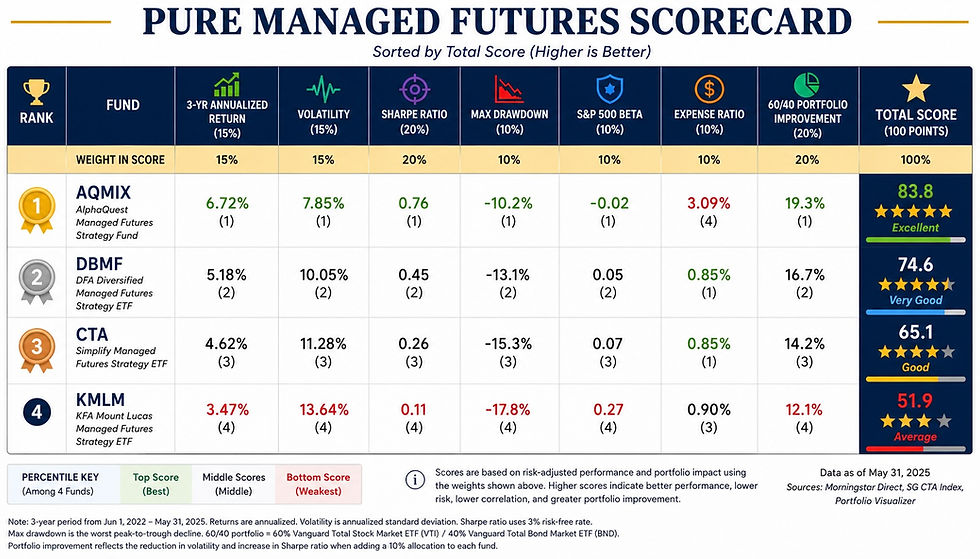
Managed Futures
Why it helps: Profit from "good" or "bad" trends created by inflation.
Managed futures strategies have historically performed well during some major inflationary periods because they can profit from persistent trends in commodities, interest rates, and currencies.
Unlike many traditional assets, they do not require inflation to be "good" or "bad" for stocks. They simply seek to identify and follow major market trends.
Commodities
Why it helps: Commodity prices often rise during inflationary periods.
However, commodities themselves generally do not produce income and can experience long periods of poor performance outside inflationary environments. They are typically better viewed as a portfolio diversifier than a core retirement holding.
Summary of the Protective Benefit of Different Asset Classes
Inflation Environment | Historically Favored Assets |
Falling inflation / disinflation | Growth stocks, long-duration bonds |
Moderate (2–4%) | Dividend stocks, broad equities |
Elevated (4–8%) | TIPS, value stocks, infrastructure |
High (8–15%) | Commodities, energy, managed futures |
Extreme (>15%) | Managed futures, commodities, foreign currencies, short-duration inflation-linked debt |
What is the evidence?
The chart above is based on a synthesis of academic research, historical market data, and practitioner studies rather than any single source. Treasury Inflation-Protected Securities (TIPS) receive the strongest support because their principal is explicitly linked to the Consumer Price Index (CPI), making them one of the few investments specifically designed to preserve purchasing power (Campbell & Shiller, 1996; Campbell, Sunderam & Viceira, 2009). Broad equities and dividend-growth stocks have historically provided good long-term inflation protection because successful companies can often pass higher costs on to customers through higher prices, allowing earnings and dividends to grow over time (Siegel, Stocks for the Long Run; Fama & French; Ned Davis Research). REITs and infrastructure investments have also demonstrated the ability to keep pace with inflation over longer periods through rising property values, rental income, and inflation-linked contracts, although they may struggle when higher inflation is accompanied by rapidly rising interest rates. Commodities have historically been among the strongest performers during periods of unexpectedly high inflation because energy, agricultural products, and industrial metals are major components of inflation itself (Gorton & Rouwenhorst, 2006; Erb & Harvey). Finally, managed futures have exhibited some of the strongest historical performance during major inflationary episodes — not because they are directly linked to inflation, but because they can profit from sustained trends in commodities, interest rates, and currencies that often accompany inflationary shocks (Hurst, Ooi & Pedersen, A Century of Evidence on Trend Following Investing; AQR; Man Group). While no single asset provides perfect protection in every environment, the evidence consistently suggests that diversification across assets that respond differently to inflation is more robust than relying on any one "inflation hedge."
What Doesn't Protect Against Inflation?
Cash
Cash is safe from volatility, but not safe from inflation.
Long-term nominal bonds
Nominal bonds, especially long-term bonds, have historically been one of the worst performers during unexpected inflation (inflation that is higher than expected when the bond was purchased).
Fixed pensions or annuities
Pensions or commercial annuities are wonderful for protecting against longevity risk. However, unless they have some type of inflation adjustment built in (and few do), their purchasing power steadily erodes with inflation.
Building an Inflation-Resilient Retirement Portfolio
Rather than trying to predict inflation, consider building a portfolio capable of handling multiple inflation scenarios.
A resilient retirement portfolio doesn't rely on a single inflation hedge. Instead, it layers multiple defenses, each protecting against inflation in different ways. That might include:
Maintaining an allocation to equities for long-term growth
Diversifying stocks (and maybe bonds) internationally across different countries and currencies
Including physical assets (real estate and infrastructure) with pricing power that have the ability to adjust prices every year
Considering strategies such as managed futures that have historically responded well during inflationary shocks
Holding TIPS for explicit inflation protection
Avoiding excessive concentration in long-term nominal bonds
Maximizing Social Security (by waiting as long as possible to claim) to build a guaranteed inflation-adjusted income stream. Read our guide to Social Security Claiming Strategies: When to Claim for more information.
Keeping enough liquid reserves to avoid selling long-term investments during periods of market stress, although cash and cash-like investments will suffer from inflation
For many retirees, delaying Social Security is one of the most powerful inflation-protection strategies available. Social Security benefits receive annual COLA adjustments and are backed by the federal government. Increasing this inflation-adjusted lifetime income stream can reduce the amount of inflation-sensitive withdrawals required from an investment portfolio.
The objective is not to eliminate inflation risk completely. It is to avoid having your retirement success depend on one very specific (relatively rosy) inflation forecast.
The Bottom Line
History reminds us to avoid anchoring our expectations solely on recent experience.
Retirement planning isn't about predicting the future. It's about preparing for futures that may look very different from the recent past.
The goal is not to guess correctly. The goal is to build a retirement plan that still works even when your guess turns out to be wrong.
The goal is to structure your portfolio and your life for resilience.
Market crashes are dramatic (earthquake like) events that capture attention. Inflation is different. It is the slow erosion (like rust) that can quietly weaken a retirement plan over decades. A resilient retirement portfolio recognizes both risks — the earthquake and the rust — and prepares for both.
Every retirement plan makes assumptions about inflation—even if they're never written down. The question is whether those assumptions are realistic and whether your portfolio can withstand a very different future. If you'd like a second opinion, I'd be happy to help you evaluate how resilient your retirement plan is under a range of inflation scenarios and identify practical ways to strengthen it.
Interested in working together? |
Next in the Retirement Risk Management Series: Longevity Risk in Retirement: Will Your Money Last.
This post is for general education and is not investment advice. Please consult a qualified professional to determine what is appropriate for your specific situation.
Author: John Macy, MBA, RICP®
John Macy is a professional financial coach and the founder of FlourishingPath Financial Coaching. With over six years of experience as a financial coach, John helps pre-retirees and retirees design resilient portfolios and income streams for their next act. Read his full story here.


Comments