
Dividends, Interest, and the 4% Rule

Updated: Oct 8
Written by John Macy, Financial Coach, MBA, Retirement Income Certified Professional® (RICP)
Introduction
If you have read about retirement income strategies, you have probably heard of the "4% Rule" — the classic guideline for how much you can safely withdraw from your investments each year in retirement. But what exactly does it mean, and how do dividends and interest fit into that rule? Do you spend 4% plus the dividends and interest you receive? Do you just spend the dividends and interest? Let’s unpack it step by step.
The Origins of the 4% Rule
The "4% Rule" is based on research conducted by William Bengen, a financial planner, in the early 1990s. In that research ("Determining Withdrawal Rates Using Historical Data") he demonstrated that a retiree with a portfolio of 50% stocks and 50% intermediate term U.S. Government bonds could withdraw 4% of the initial portfolio value from the portfolio every year (adjusted for inflation) and never run out of money over a 30-year retirement. That is the origin of the so-called "4% Rule", or what Bill Bengen called the "SAFEMAX rate". Several years later three academic researchers at Trinity University published a study (Retirement Savings: Choosing a Withdrawal Rate that Is Sustainable) confirming Bill Bengen's conclusion.
Study | Author / Source | Key Finding | Success Metric |
Bengen Study (1994) | Bill Bengen | 4% is the "SAFEMAX" withdrawal rate | 30-year portfolio survival for a 50/50 stock/bond portfolio |
Trinity Study (1998) | Trinity University | Confirmed 4% for various portfolio allocations | 95%+ success for 60/40 portfolios |
Maybe the "4% Rule" Should Be Called the "5% Rule"
For decades, the 4% Rule has served as a reliable starting point and “rule of thumb” for retirement planning. However, more recent analyses (including by Bill Bengen himself) — incorporating lower expected inflation and improved portfolio diversification — suggest that retirees today might safely withdraw a bit more, perhaps around 4.5% to 5%, without a significant increase in risk of running out of money over a typical 30-year retirement planning horizon.
In addition, research has demonstrated that flexible withdrawal and spending strategies (in contrast with the more rigid 4% Rule) such as the Vanguard Dynamic Spending Strategy, the Variable Percentage Withdrawal strategy, the RMD-based Spending Method, and the Guyton-Klinger Guardrails Strategy can enable retirees to safely withdraw and spend 5-6% of the portfolio's initial value, provided they are willing to reduce their withdrawals a bit during more significant market downturns. Read more about these Flexible Spending Strategies in this article.
So How Do Dividends & Interest Fit Into A Withdrawal Strategy?
Over the past decade an alternative approach of focusing on dividends and living off that dividend income in retirement has gained some prominence, particularly among do-it-yourself investors. The large number of articles about the dividend growth approach has stirred a significant amount of debate among investors and financial planners, especially among those that ardently espouse a total return approach with very little focus on the dividends distributed by their investments. Many proponents of the "Total Return" approach believe that those who believe in a "dividend growth" approach are misguided and unnecessarily taking on more risk by being less diversified or at least missing out on much greater portfolio return potential.
So, is dividend growth investing a valid and successful approach to investing and retirement planning? How should those who practice dividend growth investing think about the role of dividends (and interest) in their withdrawal strategies?
Much of it comes down to psychology. Research into retiree spending patterns and behavioral finance shows that retirees are much more willing to spend reliable, regular sources of income than selling volatile shares from their portfolio. David Blanchett and Michael Finke published an article (“Retirees Spend Lifetime Income, Not Savings” ) in December 2024 showing that retirees spend about 80% of guaranteed lifetime income (e.g., SS, pensions, annuities) and only about 50% of their other investment income. Malcolm Baker, Stefan Nagel, and Jeffrey Wurgler published an article in 2006 (“The Dividend Effect on Consumption”) providing evidence that retirees preferred spending dividends and bond interest, and viewed the sale of stock as a last resort.
Because of these psychological and behavioral finance reasons, many retirees choose to focus on earning dividends and interest from their investments because they tend to be more reliable and stable sources of income than depending on selling shares of stock that experience periods of high price volatility. Personal psychology, priorities, and preferences are important factors in the decision about how to construct a retirement income portfolio.
Beyond personal preference and psychology, there is some evidence that dividend growth stocks can and do perform well over long periods of time. As illustrated in the graphic below, studies by Ned Davis Research and others have shown that (on average) stocks of companies with regularly growing dividends tend to have higher total returns than companies with flat dividends, declining dividends, or no dividends.
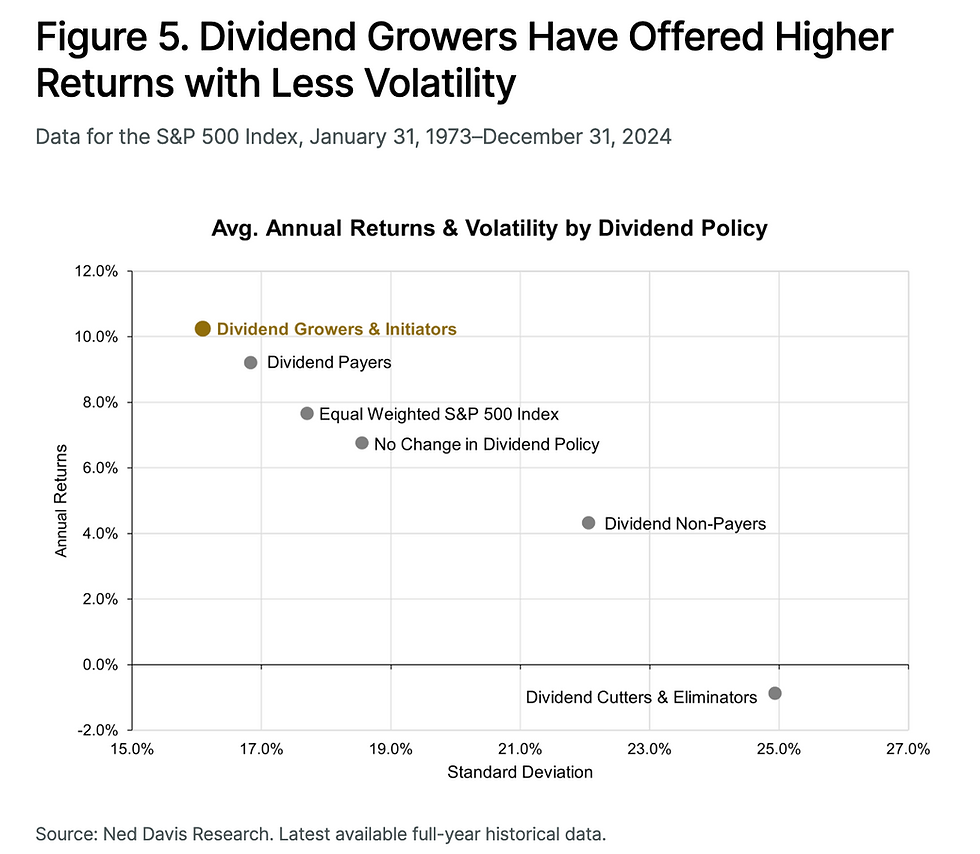
Thus, focusing on dividend growth stocks is a perfectly valid investment strategy, provided that the investor maintains a diversified portfolio and does not chase lower-quality, higher-yielding stocks. This point is emphasized and discussed more fully in this article.
It is important to note, however, that there is a bit of tax drag on dividends and interest received in a taxable brokerage account depending on the investor's marginal tax bracket. Thus, especially during the accumulation phase (pre-retirement), an investor can often earn better after-tax returns by investing in low-cost, low turnover, broadly diversified stock index funds in a taxable brokerage account rather than stocks or mutual funds/ETFs that distribute a lot of dividend income.
What is the Relationship of Dividends to Total Return?
A key principle to keep in mind is that dividends and interest are part of an asset’s total return — they are not extra. Every investment’s total return is made up of two components:
Total Return = Dividend/Interest + Price Appreciation (Growth) |
Many investors mistakenly assume dividends and interest are on top of their portfolio’s total return. In reality, they are components of total return.
Example: If your mutual fund earns a 7% total return in a year, that might include 2% from dividends and 5% from price appreciation.
When applying the 4% Rule (or the 5% Rule, or a flexible spending strategy depending on your preference and situation), you are drawing from the total return — not just from the growth portion or the dividend portion.
Spend Income First in Taxable Accounts
However, if you have taxable brokerage accounts, you will pay taxes on dividends, capital gains, and interest you receive every year — whether you spend that income or reinvest it. That means when you are drawing retirement income, it usually makes sense to spend your dividends and interest first before selling shares or pulling money from tax-deferred accounts (like IRAs or 401(k)s).
Otherwise, you could end up:
Paying taxes on income you didn’t actually use, and then also
Paying capital gains taxes when you sell shares for cash, and/or
Paying ordinary income tax on withdrawals from IRAs and 401(k)s.
By spending the income you are already taxed on, you reduce additional tax drag by selling shares and keep more of your portfolio working for you. Read this article for more guidance on portfolio withdrawal strategies in retirement.
Additionally, asset location — the strategy of placing tax-efficient investments in taxable accounts and tax-inefficient ones in IRAs — can further minimize your lifetime tax bill. (See my related blog post "Tax-Efficient Asset Location" on this topic.)
The Bottom Line
Dividends and interest are not “extra” returns — they are part of your portfolio’s total return. When following the 4% Rule (or a similar safe withdrawal framework), understanding how that income fits into your total return — and how to use it efficiently — can make a significant difference in your after-tax outcomes.
A smart withdrawal plan is not just about how much you take out; it is also about where the money comes from and how it is taxed. By utilizing both proper withdrawal strategies and proper asset location strategies, you can shield your bonds, dividend stocks, and REITs from taxes, allowing your portfolio to grow faster and your withdrawals to go further in retirement.
If you want to optimize your withdrawal sequence, tax strategy, and income sustainability in retirement, consider building a personalized withdrawal plan that fits your portfolio, tax situation, and lifestyle goals.
Interested in working together? |
Related Links:
This post is for general education and is not investment advice. Please consult a qualified professional to determine what is appropriate for your specific situation.
Author: John Macy, MBA, RICP®
John Macy is a professional financial coach and the founder of FlourishingPath Financial Coaching. With over six years of experience as a financial coach, John helps pre-retirees and retirees design resilient portfolios and income streams for their next act. Read his full story here.

Comments